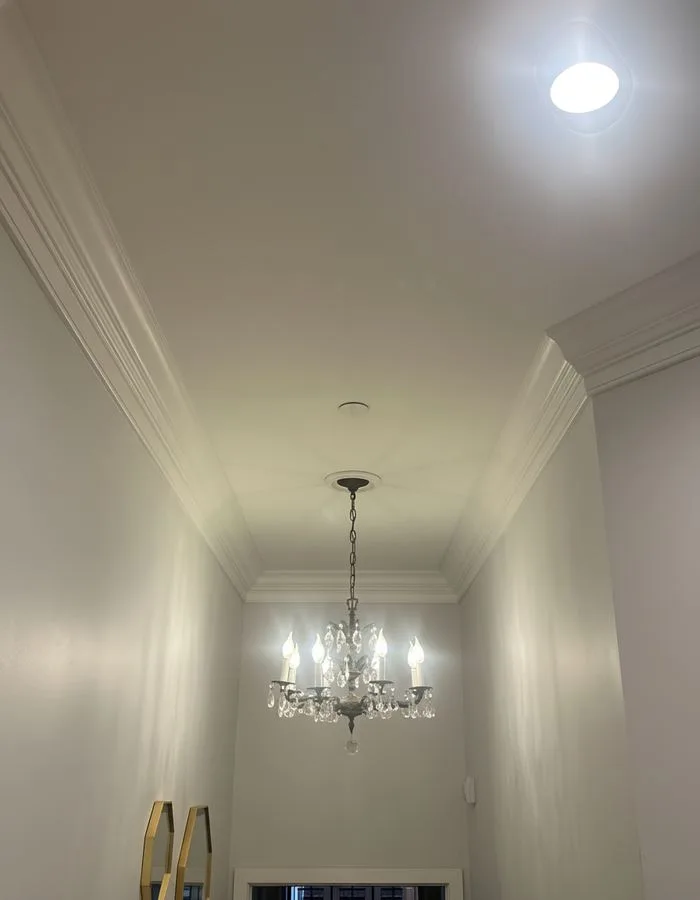
A long painted crown molding run through a hallway, exposed to seasonal heating and cooling
If you have wood trim in your home, there is a good chance you will eventually see a small crack, gap, or paint line open up somewhere. It may show up at crown molding, baseboards, door casing, window casing, wainscoting, picture frame molding, or along a wall panel detail.
That does not automatically mean something was installed wrong.
Most interior paint-grade trim is made from pine or poplar. Both are great materials for finish carpentry, especially when they are being painted. They cut well, paint well, and give a clean finished look. But they are still real wood, and real wood moves.
Wood Trim Moves With the Seasons
The main reason trim cracks over time is seasonal humidity change.
In the summer, the air inside a home usually carries more moisture. In the winter, once the heat is running, the air inside the home gets much drier. When that happens, pine and poplar trim can shrink slightly.
That small amount of movement can cause:
- Hairline cracks in caulk
- Small gaps at crown molding joints
- Open miters on casing or wall molding
- Separation where trim meets drywall
- Minor paint cracks along trim edges
This is very common in homes throughout Delaware County, PA, the Main Line, Greater Philadelphia, Chester County, and Montgomery County because our area gets real seasonal changes. Hot, humid summers and dry heated winters are tough on wood trim.
Why It Often Shows Up Months Later
A lot of homeowners notice this a few months after the work is finished and wonder why it did not show up right away.
That is because the trim may have been installed when the home was at one humidity level, then went through a completely different season later. For example, crown molding installed in the summer may look perfect when it is finished. Then winter comes, the heat runs every day, the air dries out, and a small caulk line or miter joint may open up.
That first full year is usually when trim movement is most noticeable because the material is going through its first full cycle inside the home.
Does This Mean the Trim Was Installed Wrong?
Not necessarily.
There is a big difference between poor workmanship and normal seasonal movement.
A bad installation may have loose trim, sloppy cuts, poor fastening, large uneven gaps, or joints that were never tight to begin with. Normal seasonal movement is usually much smaller. It often shows up as a thin crack in the caulk or paint line after the home goes through a heating or cooling season.
Proper installation absolutely matters. Clean cuts, tight joints, proper fastening, good caulk, and the right installation methods all help reduce movement. But no carpenter, caulk, or paint can completely stop pine or poplar from reacting to humidity.
Good finish carpentry helps control the issue. It does not make wood stop being wood.
Where Trim Cracks Usually Show Up
The most common areas are where trim meets another surface or where two pieces of trim meet each other.
You may see it at:
- Crown molding where it meets the ceiling
- Baseboards where they meet the wall
- Door and window casing miters
- Picture frame molding joints
- Wainscoting and wall panel seams
- Board and batten trim
- Cabinet crown molding
- Coffered ceiling trim details
- Long runs of pine or poplar molding
Larger trim details and longer runs are more likely to show some movement because there is simply more material expanding and contracting.
What Is Considered Normal?
Small hairline cracks are usually normal, especially if they appear during the winter or along a caulk line.
A small crack where crown molding meets the ceiling, a minor gap at a casing miter, or a thin line along wall molding is usually cosmetic. In many cases, it can be touched up with paintable caulk and paint after the trim has gone through a full seasonal cycle.
This is part of normal home maintenance, especially with painted wood trim.
When It May Be More Than Normal Movement
Most small cracks are not a major concern. However, some signs should be looked at more closely.
You may have a bigger issue if you see:
- Large gaps that keep growing
- Trim pulling away from the wall
- Soft or swollen wood
- Water stains
- Peeling or bubbling paint
- Musty smells
- Cracks that come back immediately after repair
Those issues may point to moisture, leaks, framing movement, or excessive humidity instead of normal trim movement.
How LM Legacy Remodeling Handles Trim Installation
At LM Legacy Remodeling, we install trim with the understanding that homes move and wood moves.
For crown molding, wainscoting, picture frame molding, board and batten, baseboards, casing, custom built-ins, coffered ceilings, and cabinet trim, the goal is to make the work clean, tight, and durable from the start.
That means paying attention to:
- Accurate measuring and layout
- Clean cuts and tight joints
- Proper fastening
- Strong, stable trim details
- Quality paintable caulk
- Clean prep before paint
- Realistic expectations for long-term performance
The goal is not just to make the trim look good the day it is installed. The goal is to install it in a way that holds up as well as possible through normal seasonal changes.
The Straight Answer
Small cracks and gaps in painted wood trim are common. Pine and poplar are natural materials, and they move as humidity changes inside the home.
Proper installation helps reduce cracking, but it cannot eliminate seasonal movement completely.
In most cases, small trim cracks are cosmetic and can be touched up as part of regular home maintenance. If the cracking is large, keeps getting worse, or comes with signs of water or structural movement, then it should be inspected.
Frequently Asked Questions
Why is my crown molding cracking?
Crown molding often cracks because it sits between the wall and ceiling. Those surfaces can move slightly, and dry winter air can cause pine or poplar crown molding to shrink.
Why are my baseboards separating from the wall?
Small gaps at baseboards are usually caused by seasonal movement between the trim, wall, and floor. Minor gaps are usually cosmetic.
Is it normal for wainscoting or wall molding to crack?
Yes. Small cracks in wainscoting, picture frame molding, board and batten, and applied wall molding can happen as the trim and drywall move slightly over time.
Can cracked trim be fixed?
Yes. Most small cracks can be touched up with paintable caulk and paint. Larger or repeated cracks may need to be inspected or repaired differently.
Is poplar better than pine for trim?
Poplar is usually smoother and a little harder, while pine is widely used and cost-effective. Both are common for painted trim, and both can move with seasonal humidity changes.
Thinking About a Project Like This?
Free estimates directly with the owner, who works with you from the first measurement to the final walkthrough.
📞 Call 484-995-8599 💬 Text Photos of Your Space